There is one building on earth that most people can picture in perfect detail before they have ever visited it: the Taj Mahal. Perfectly symmetrical. Almost impossibly white. Glowing differently at sunrise, at noon, and under a full moon. What most people standing in front of it don’t realize is that this effect, that sense of the stone holding light rather than just reflecting it, is not magic. It’s geology. The material responsible is a specific white marble from a small town in Rajasthan called Makrana. And it is called Makrana marble.
Quarried continuously for over five centuries, recognized as a Global Heritage Stone by international geological bodies, and still worked by master craftsmen in Udaipur today, Makrana marble is not just the material of a famous monument. It is a living craft tradition, one that Marvel Stone Aura connects directly to homes across the United States. This guide covers everything: what Makrana marble actually is, why it is different from every other white marble in the world, its history from the Mughal court to the present day, and how to bring it into your own home.
What Is Makrana Marble?
Makrana marble is a high-purity white dolomitic marble quarried exclusively in Makrana, a town in the Nagaur district of Rajasthan, northwestern India. It has been designated a Global Heritage Stone Resource by the International Union of Geological Sciences, one of only a small number of natural stones worldwide to receive that recognition, reflecting both its extraordinary material properties and its irreplaceable role in architectural and craft history.
What makes Makrana marble genuinely different from all other white marbles, Italian Carrara, Greek Thassos, Turkish Afyon, is a combination of three properties that do not typically occur together in any other stone:
- Exceptional purity, Makrana marble contains 90–98% calcium carbonate and dolomite, producing a white that does not yellow or discolour with age. The Taj Mahal is over 370 years old and still white. No other stone has done that.
- Translucency, light enters the surface slightly before being reflected back, producing the glow that makes the Taj Mahal appear to change colour from dawn through dusk to moonlight. This optical property is unique to Makrana among the world’s major white marbles.
- Dolomitic hardness, its mineral composition gives it significantly greater hardness than standard calcite marble, meaning carved pieces hold their edges and surface detail across generations of use.
The Geology Behind the Stone
The Makrana deposit sits within the Aravalli mountain range, one of the oldest mountain systems on earth, estimated at approximately 2.5 billion years old. The marble itself formed through the metamorphic transformation of limestone under sustained heat and pressure over roughly 800 million years. This extended geological process, in these specific mineralogical conditions, produced a stone composition found nowhere else on the planet.
The deposit is estimated at several kilometres depth and currently produces approximately 19 million tonnes annually. What is remarkable is that the core quality defining Makrana, that combination of purity, translucency, and hardness, remains consistent across the formation. Other white marbles, including Italian Carrara and Calacatta, are calcite-dominant and structurally softer. Their properties cannot be replicated in Makrana, and Makrana’s cannot be replicated in them. They are fundamentally different stones.
The Taj Mahal: Where Makrana Marble Made History
In 1631, Emperor Shah Jahan commissioned a mausoleum for his wife Mumtaz Mahal. What followed was one of the greatest construction projects in human history: twenty-two years, an estimated twenty thousand workers and craftsmen, and somewhere between twenty and twenty-eight thousand tonnes of Makrana marble transported three hundred kilometres from the quarries by bullock cart and river barge.
The choice of Makrana was deliberate and precise. Shah Jahan’s chief architect, Ustad Ahmad Lahauri, specified it because of its translucency, the property that allows the Taj Mahal to appear internally lit rather than simply surface-reflective. The building looks different at every hour of the day, blush pink at dawn, brilliant white at noon, warm gold at dusk, and silver under moonlight, not because of different light sources but because of how Makrana marble processes and re-emits light.
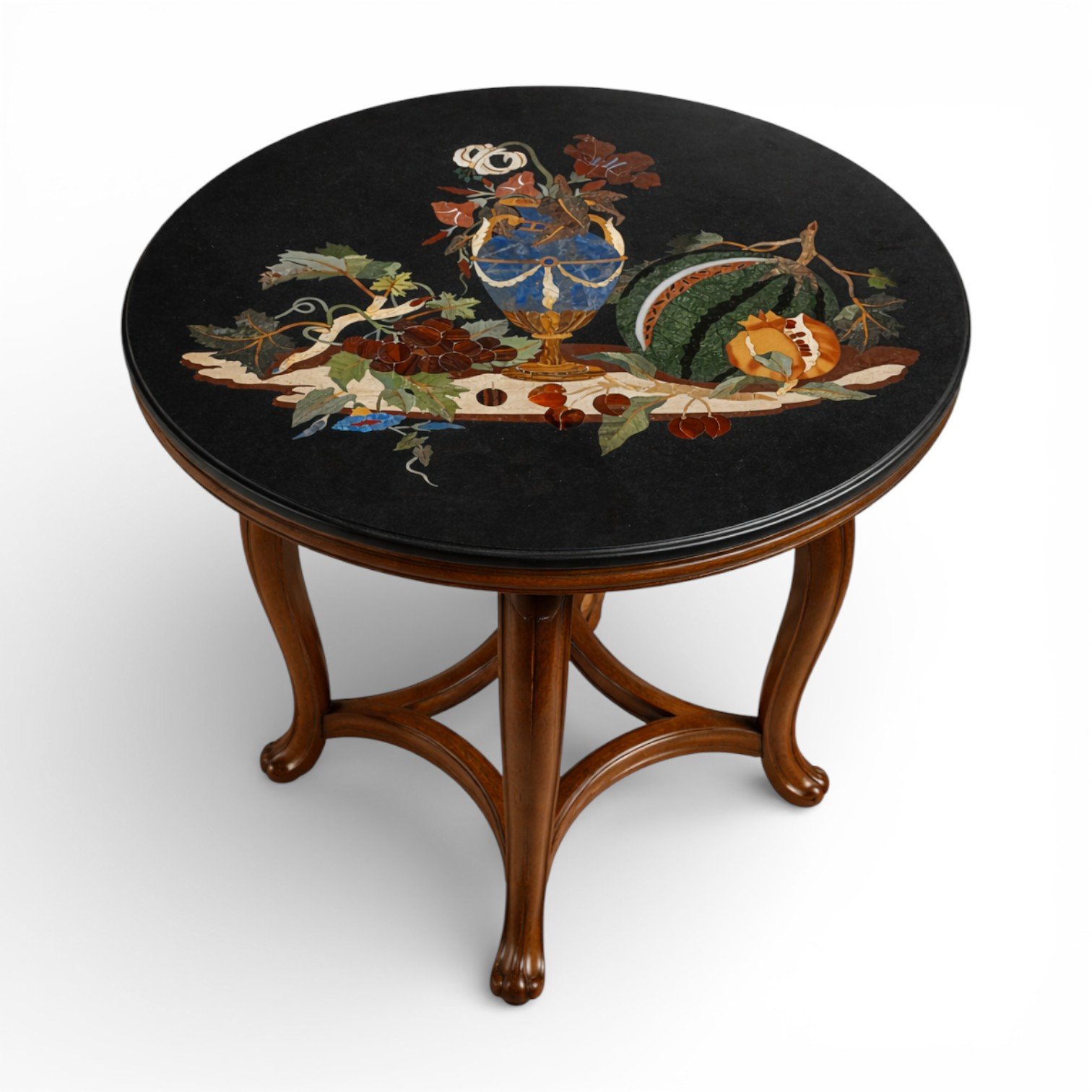
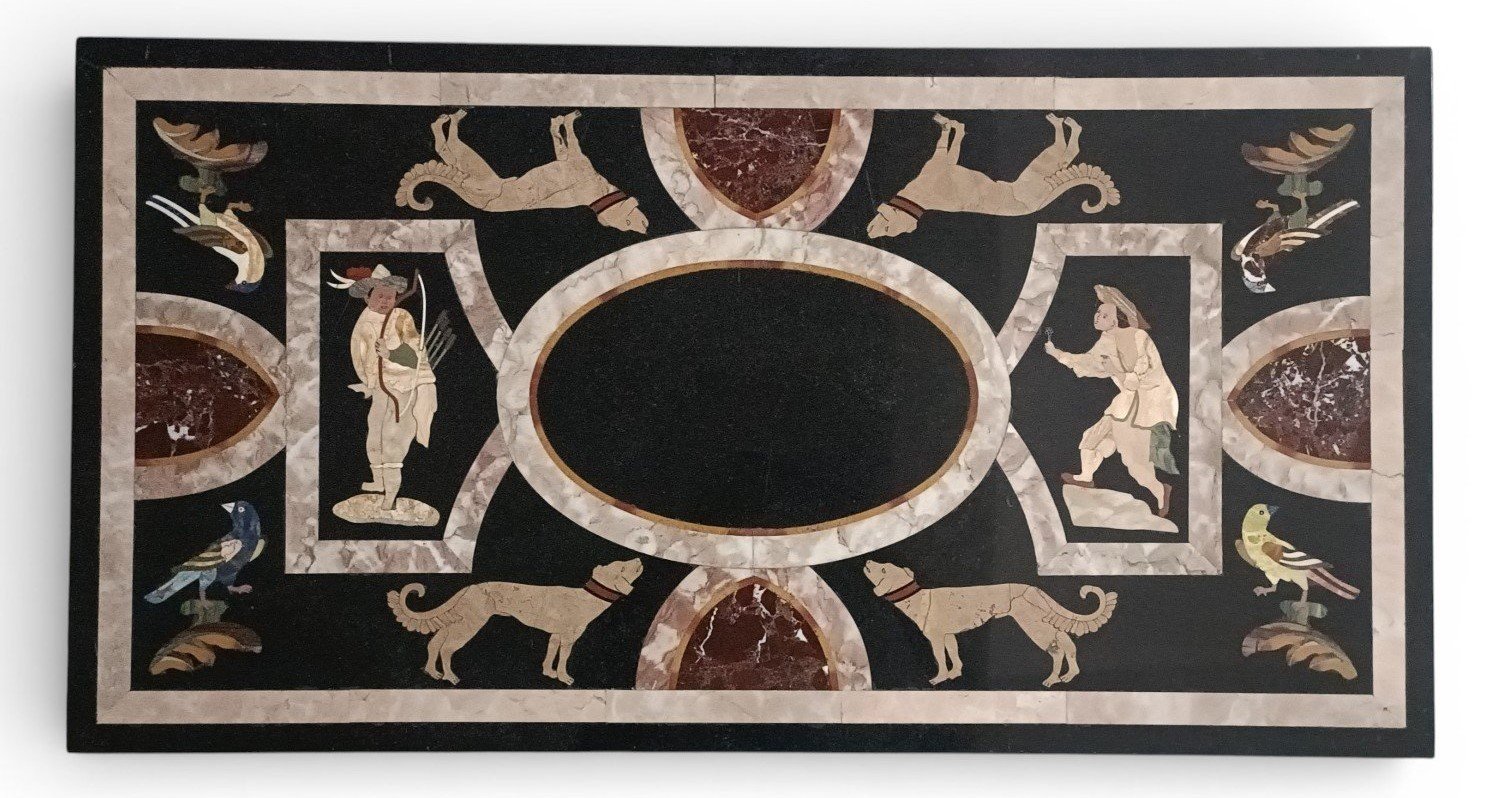
The interior walls of the main chamber are inlaid using the Pietra Dura technique: semi-precious stones, lapis lazuli, carnelian, malachite, onyx, mother of pearl, cut and fitted into the Makrana marble base with such precision that the joints are invisible to the naked eye. This is the same stone inlay tradition that the artisans Marvel Stone Aura works with in Udaipur practise today.
You can see this tradition in our own stone inlay paintings and marble tabletop collection, pieces that use the same Pietra Dura methods applied to the Taj Mahal’s interior walls, made by master craftsmen in the same city.
From the Taj Mahal to Udaipur: The Living Craft Tradition
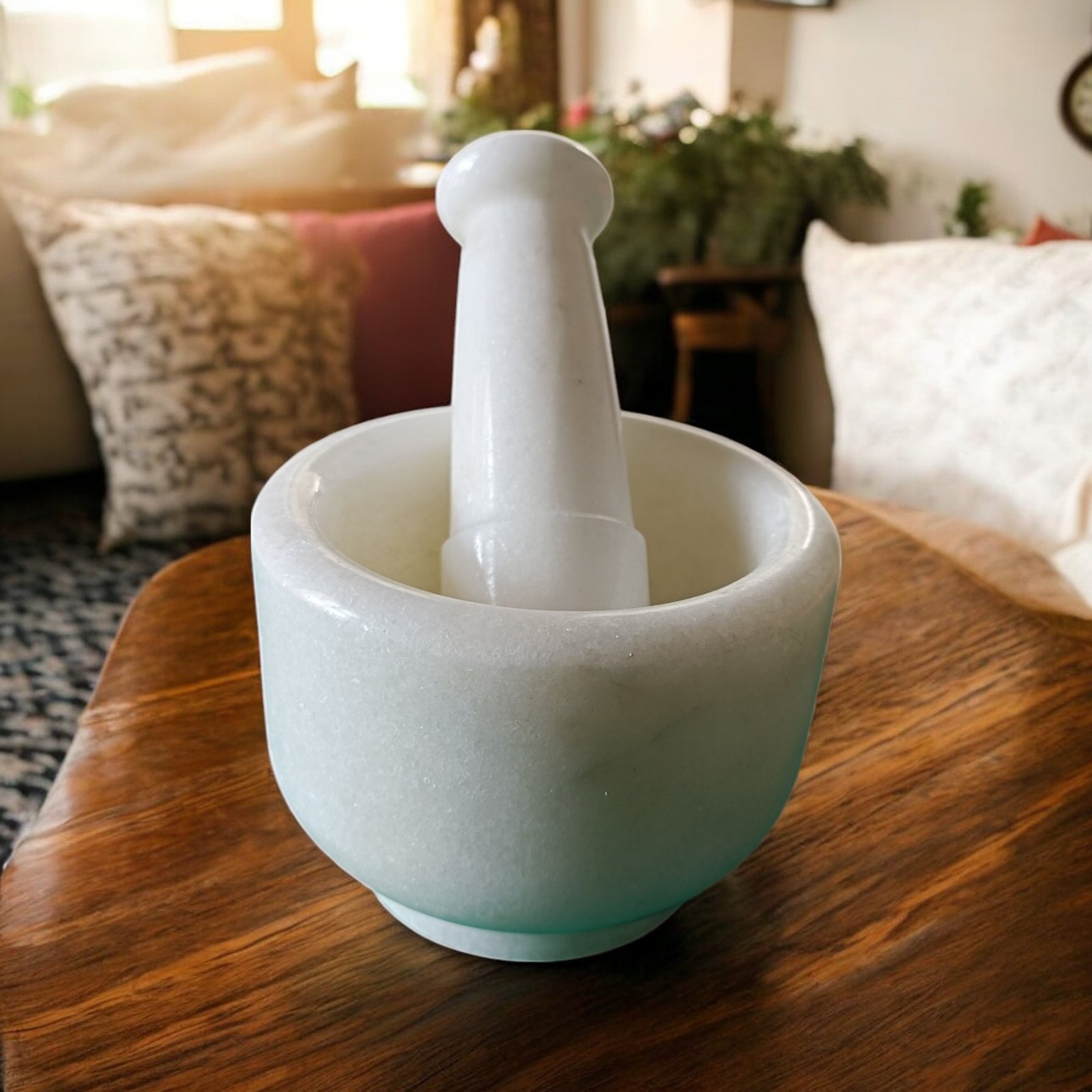
After Mughal patronage declined in the 18th century, the stone-carving knowledge concentrated in Rajasthan, particularly in Udaipur, the City of Lakes. Udaipur sits at the geographic heart of India’s marble quarrying region, and its artisan families built a tradition of working Makrana marble into domestic and decorative pieces: bowls, vessels, trays, candle holders, inlay panels.
This knowledge was transmitted within families, from master to apprentice, across three and four generations. The artisan workshops of Udaipur that Marvel Stone Aura partners with today are direct continuations of the same craft lineage that produced the decorative arts of the Mughal court. When you place one of our marble bowls on your kitchen counter or coffee table, you are handling something made by people whose skills connect in an unbroken line to the craftsmen who built the Taj Mahal.
Browse our full range of handcrafted marble bowls, each one carved from genuine Makrana marble by the artisan families of Udaipur.
Makrana Marble vs. Other White Marbles: Key Differences
People often ask whether Makrana is ‘better’ than Carrara or Calacatta. It’s the wrong question, they are different stones with different properties. Here is a clear comparison:
| Marble | Origin | Composition | Hardness | Translucency |
|---|---|---|---|---|
| Makrana | Rajasthan, India | Dolomitic (90–98%) | High | High, unique glow |
| Carrara | Tuscany, Italy | Calcitic | Medium | Low |
| Calacatta | Tuscany, Italy | Calcitic | Medium | Low |
| Thassos | Greece | Calcitic | Medium-high | Low–medium |
| Afyon | Turkey | Calcitic | Medium | Low |
The translucency column is the one that matters for home decor. It is what gives a Makrana marble bowl its quality of looking different in morning light versus evening lamplight. A bowl carved from Carrara marble is beautiful. A bowl carved from Makrana marble is alive.
How Makrana Marble Is Carved Today in Udaipur
Every piece in Marvel Stone Aura’s collection goes through a six-stage hand-carving process in the workshops of Udaipur:
- Rough cutting, a Makrana slab is cut to approximate dimensions with a diamond-tipped saw.
- Form shaping, angle grinders establish the rough profile of the piece.
- Detail carving, hand chisels and files define the designed surface: lotus petals, scalloped edges, fluted profiles. This stage requires the most skill and takes the longest.
- Initial sanding, progressive hand-sanding through coarse, medium, and fine grades smooths the carved surface.
- Polishing, multiple stages with progressively finer abrasives bring up the final glassy surface and activate the stone’s translucency.
- Quality check, each piece is inspected for consistency and surface quality before packing.
Because every piece is hand-finished, no two items are identical. The natural veining of Makrana marble follows its own path in every slab; the polish develops subtly from piece to piece. This is the definition of genuine handcraft, and it is what makes each piece genuinely unique.
Makrana Marble Pieces Handcrafted in Udaipur, Shop Marvel Stone Aura
Every piece in Marvel Stone Aura’s collection is carved from genuine natural marble by Udaipur’s master artisans. Here are some of the pieces most directly connected to the Makrana tradition:
Marble Bowls, The Purest Expression of Makrana White
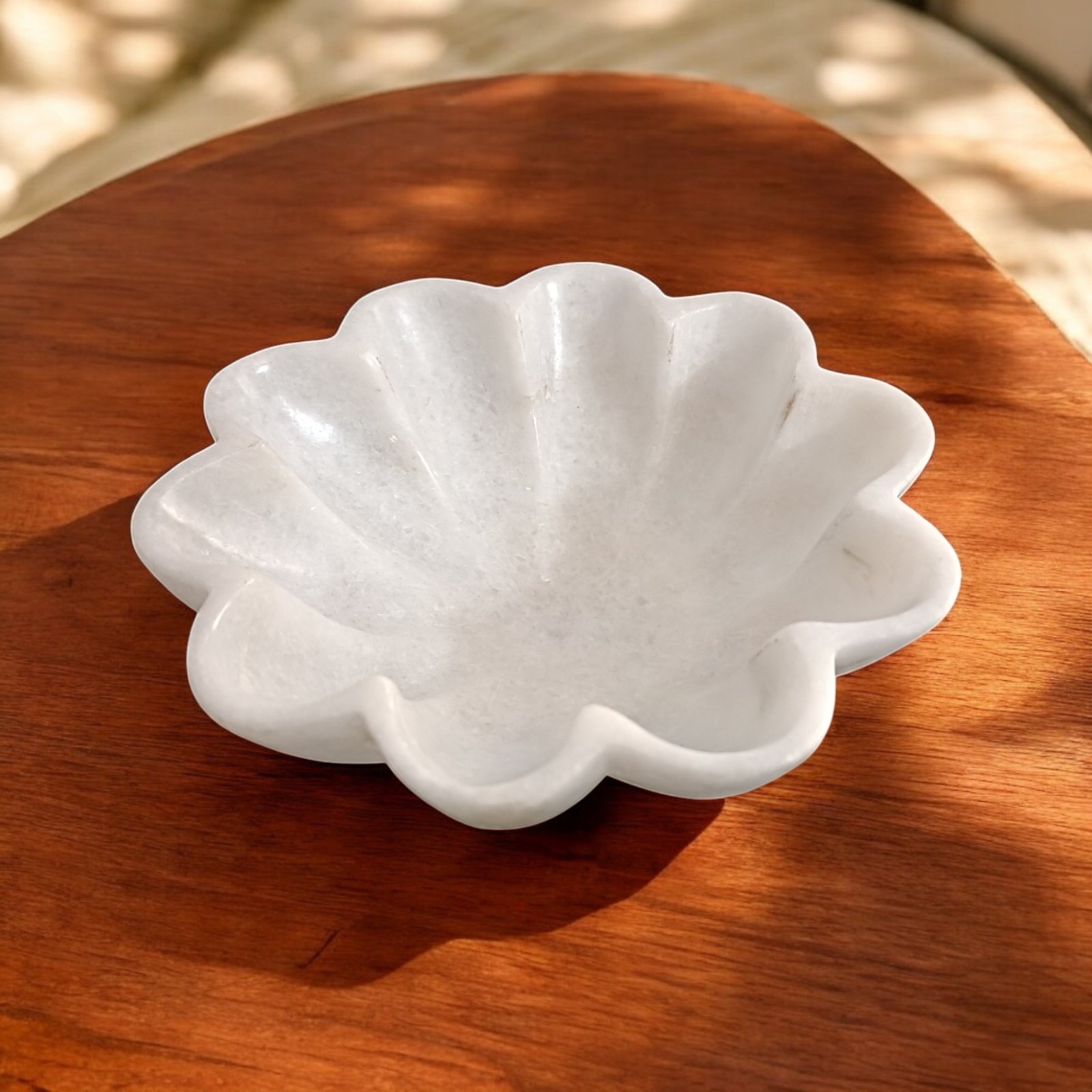
★ Sunburst Pleated Marble Statement Bowl – 9 Inch , $110 | Sunburst pleating that shows off Makrana’s translucency beautifully in any light.
★ White Petal Fluted Marble Decorative Bowl – 9 Inch , $130 | Hand-carved petal fluting in luminous white marble, sculptural and functional.
★ Handcarved White Petal-Edge Marble Bowl – 15 Inch , $190 | Large-format centrepiece, the petal edge at this scale commands any dining table.
Browse the full range: Marble Bowls Collection
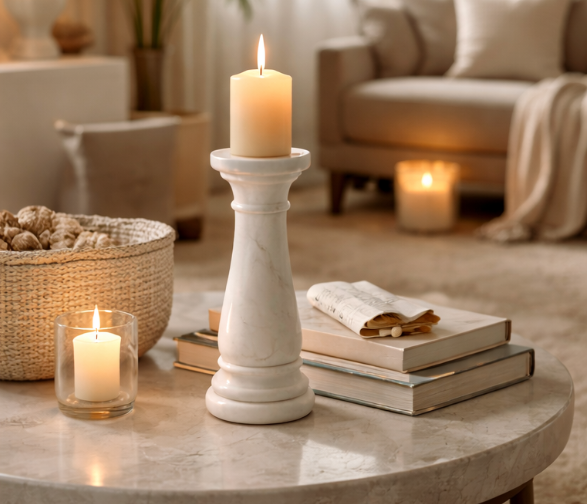
Marble Candle Holders, Makrana White Meets Candlelight
★ Lotus Shape White Marble Candle Stand – 9 Inch , $99 | The lotus form, one of the oldest motifs in Indian stone craft, in hand-carved Makrana white.
★ White Marble Shrine Candle Stand – 7.5 Inch Arched Niche , $115 | Inspired by the arched niches of Mughal monuments. Architecture at desk scale.
Browse the full range: Marble Candle Holders Collection
Stone Inlay Art, The Pietra Dura Tradition
★ Black Marble Pietra Dura Round Tabletop – 34 Inch , $4,999 | The Taj Mahal technique at its most ambitious. A once-in-a-lifetime centrepiece.
★ Luxury Handcrafted Black Marble Inlay Table with Floral & Bird Design , $999 | Pietra Dura floral and bird inlay, every stone hand-cut and hand-fitted.
Browse the full range: Stone Inlay Art & Marble Tabletops
Use code AURA50 for $50 off orders over $300. Free shipping across the USA including California, Texas, and all 50 states.
Frequently Asked Questions (FAQ)
Q1. Why is Makrana marble so famous?
Makrana marble is famous above all because it is the material of the Taj Mahal, the most recognised building on earth. But the fame is grounded in real properties: a purity that prevents yellowing over centuries, a translucency that produces a glow no other white marble can replicate, and a hardness that allows carved detail to survive for generations. It has been formally designated a Global Heritage Stone Resource by the International Union of Geological Sciences.
Q2. Is Makrana marble better than Carrara marble?
They are different stones suited to different purposes. Makrana’s dolomitic hardness makes it better for carved objects that need to hold detail over decades. Its translucency makes it the superior choice for pieces where the quality of light through the stone matters. Carrara is a calcite-dominant marble prized for its workability in large-format sculpture and architectural surfaces. For hand-carved decorative objects in the Indian tradition, Makrana is the definitive material.
Q3. Where does Makrana marble come from?
Makrana marble comes exclusively from the town of Makrana in the Nagaur district of Rajasthan, northwestern India, approximately 110 km west of Jaipur. The deposit sits within the Aravalli mountain range. No other location produces the same stone.
Q4. How do I care for a Makrana marble piece at home?
Wipe clean with a soft damp cloth and a pH-neutral cleaner. Avoid acidic cleaners (vinegar, lemon-based products) which can etch the polish over time. Apply a marble sealant once a year if the piece is used with food or liquids. For dry display pieces, no sealing is necessary. Makrana’s lower porosity makes it more forgiving than softer marbles.
Q5. Are Marvel Stone Aura’s pieces made from genuine Makrana marble?
Yes. Our artisan partners in Udaipur source genuine Makrana and Rajasthani marble from the Nagaur quarrying region, the same geological formation that has supplied the marble craft tradition for five centuries. Every piece is hand-carved using traditional methods. For questions about a specific piece or to discuss a custom order, contact us here.
Q6. Does Marvel Stone Aura ship Makrana marble pieces to the USA?
Yes, free shipping to all 50 states. Each piece is individually packed and insured for transit. Browse the complete collection at marvelstoneaura.com/shop, or go directly to marble bowls, marble candle holders, or marble serving trays.
Browse Our Handcrafted Marble Collection
Marvel Stone Aura's handcrafted marble pieces are made for homes that take design seriously. Every piece is carved by master artisans in Udaipur, India, the centuries-old heart of India's marble craft tradition.Free shipping to all 50 states.
Use code AURA50 for $50 off orders over $300. Free shipping across the USA including Miami, Fort Lauderdale, and all of South Florida.
Browse the full range : Marvel Stoneaura Shop